
Introduction to Renaissance Stained Glass
Experience Our Service
Renaissance Stained Glass are specialists in traditional stained glass and leadlight creation, repair, and conservation, situated on Sydney’s North Shore.
Our expertise encompasses a range of styles including heritage, ecclesiastical, residential, and modern designs. We offer services in new creations of Stained Glass windows and doors, restorations, and conservation.
Whether your property is rich in history, or you seek a contemporary take on classic designs, we provide tailored assistance to meet your design requirements, complete with an extensive hands-on selection process for glass colors and textures. Contact us to find out more.

Our Services
Design Consultation
Our designs are bespoke, and our service includes providing the very best outcome with your guided input.
Manufacture & Installation
Everything we provide is handmade in-house and this extends to skilled installation.
Heritage Planning Consultation
Development Application documentation & supporting documentation impacting Heritage items.
Condition Report Consultation
Comprehensive condition reporting for significant items, insurance valuations, and more extensive scope-of-works documentation.
Protective Glazing & Brass Mesh
Protective options for sensitive or vulnerable stained glass in Heritage listed items.
Gallery
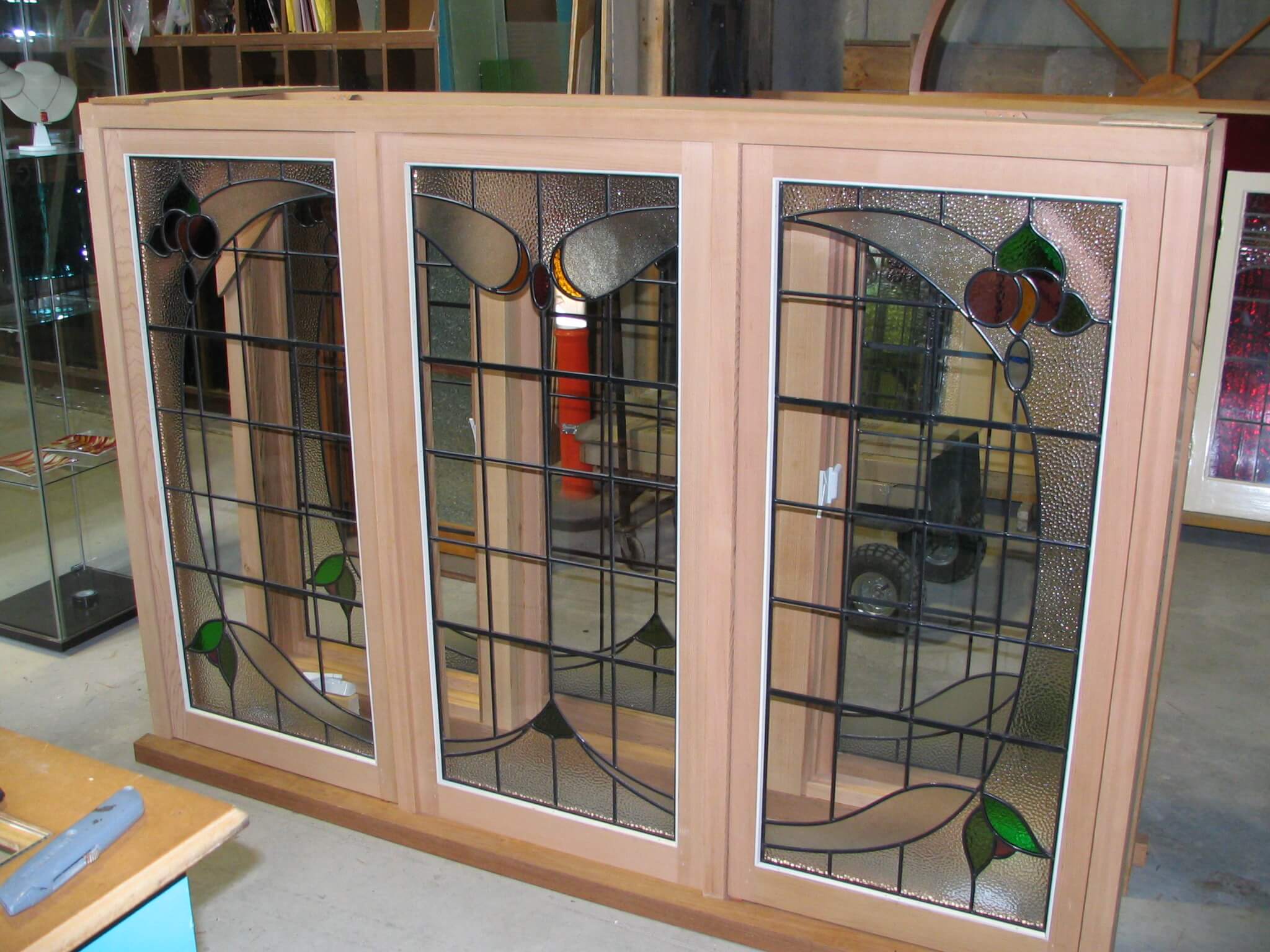
Browse a selection of period styles to gain a clearer understanding of the potential options available.
More About Stained Glass
Stained Glass brings about memories of childhood homes, fond recollections of visiting Grandparents, or even trips to myriad European churches. It’s beautiful and romantic play on light is an awe inspiring representation of an ancient skill that is second to none in its beauty and creative extravagance.
There are very many questions that you may have before moving forward with a project of your own. Please allow us to answer some of the most frequently asked questions for you below:
What is Stained Glass?
The International Committee of the Corpus Vitrearum for the Conservation of Stained Glass in association with the Stained Glass Committee of ICOMOS, in guidelines that were first established in 1989: the term “stained glass” covers painted and/or stained glass as well as plain leaded lights, copper-foiled glass, dalle de verre and other types of architectural glass, whether in situ or after removal to a museum or private collection.
In more specific terms it could be described as a composite glazing system that maximises the comparatively limited size of manufacturable glass of pre and post-industrial times. Whether the glass is coloured or not, when combined with additional materials including but not limited to lead, zinc, copper, solder, putty or concrete, could give a larger and more beneficial aspect than might have otherwise been achieved through individual pieces of glass alone.
What is the History of Stained Glass?
•1st Century – The first simple windows were made by the Romans.
•6th Century – The earliest example of ecclesiastical stained glass is possibly that from San Vitale in Ravenna, Italy. A clear glass roundel with a depiction of Christ in Majesty was discovered.
•9th Century – Later coloured examples dating from 800-820 were unearthed in excavations at the Abbey of San Vicenzo in Volturno, Italy.
•11th Century – The oldest surviving in situ stained glass is in St Mary’s Cathedral, Augsburg, Germany. Dating back to c.1065 they depict five prophets: David, Jonah, Daniel, Moses, Hosea. The windows are situated in the southern clerestory and may be the remnants of a larger original number. Later 14th century mediaeval examples depicting the story of Mary also remain in the cathedral.
•16th Century -The popularity of stained glass continued until religious and political flux in Britain and greater Europe brought about devastating change. The Protestant reformation saw many windows removed, destroyed, and replaced with plain glass because of their “abused images”, despite their once pious roles as poor man’s bible for the masses. Henry VIII also dissolved the abbeys and as a consequence this lead to a decline in skills and knowledge honed by the monks and only very simple grisaille style windows were made after this time. A useful 12th-century source on medieval glass manufacture is the De Divers Artibus of Theophilus Presbyter, a Benedictine Monk.
•17th Century – The English Civil War (1642-1651) also saw an extension of the puritanical view toward stained glass as anecdotal stories told of parliamentarian soldiers being paid to shoot out the faces in windows at York Minster testify.
•18th Century – The French Revolution (1789-1799) had similar impact between neglect and destruction to mediaeval windows.
•18th Century – The Gothic revival saw an increase in interest in the art form and by the:
•19th Century was backed by the likes of John Ruskin, and later William Morris. Augustus Welby Pugin was probably the greatest proponent of the craft in Britain as he set about converting once Catholic churches converted to Protestantism, back to their former Catholic grandeur. Influenced greatly by the work of Pugin, Edmund Blacket brought his influences and ideas to Australia in 1842. With the expansion of the church and secular developments in Australia, stained glass featured heavily in these plans 1840 – 1930 with the peak being 1860 – 1890. This “hay day” or “golden era” (literally thanks to the gold rush) could be said to outdo the efforts in Europe owing to the ground up building developments taking place.
•20th Century –Swept up by trends and fashions stained glass manufacture continues on greatly reduced terms to the present day.
How long does Stained Glass last?
In protected areas, Stained Glass can last for decades; it’s not uncommon to find original stained glass that is 100 years old or more. With that said it depends on where the Stained Glass is installed and how exposed to the elements it is and other impactful conditions. Stained Glass that is in full sun or other elemental impacts will deteriorate far faster than if it is in shade and under cover. The place that it is installed into is also a governing factor for more rapid breakdown. Moving units such as doors or window sashes can also exacerbate an untimely breakdown if high winds or slamming are a regular occurrence. In a typical domestic scenario where care is taken to regularly clean glass, polish lead, and avoid door or window slamming, it should be reasonable to expect a lifespan of 25 – 50 years from your Stained Glass.
How much does Stained Glass cost?
By its very nature, Stained Glass is a time-consuming process to manufacture. Materials are made and gathered from all over the world and brought to Australia. Design complexity and opening size are also both governing factors. Traditional Leaded Lights of either squares or diamonds using clear glass cost approximately $2000.00 per square meter. More complex designs with multiple colours cost Approximately $3500.00 per square meter. A typical Federation front door then, with an opening of approximately 90cm high x 70cm wide would cost around $1600.00 + installation and GST.
Can Stained Glass Be Repaired & How Often?
Yes, Stained Glass can be repaired but if well looked after should be on a “needs, must” basis. If your front door has to be slammed for it to close, or your window hardware fails to hold the open window in a high wind, then this will see you needing to repair your Stained Glass more often. Most often a rogue ball or misguided item hits the glass and causes localised damage. This can be repaired in situ if the rest of the panel is in good order. Over time, Stained Glass will break down more discretely. Most often Stained Glass is made up of glass, lead, solder, and sealant. It is quite evident when a piece of glass is broken, but less obvious when sealants start to dry out, solder joints start to crack, and lead oxidises to the point of breakage. These too can be fixed but are more involved and costly. With that said, the more involved repair process gives back decades of life is greater care is taken into the future.
Who Should You Trust to Repair Your Stained Glass?
There is no one standout qualification in Australia for the manufacture or repair of Stained Glass. A glazier is licensed to install large format monolithic glass like shower screens and pool fences. This training does not always include making, repairing, or even handling Stained Glass and care should be taken to select a business or sole practitioner that is both familiar with, and experienced in handling Stained Glass and or repairs.


 Renaissance Stained Glass